IUMI response — 28 July 2026
IUMI has replied to the Global Stop Live Exports Network’s letter on risk in the global livestock carrier fleet.
IUMI agreed that awareness of the risks in this trade matters and that its reputational dimension deserves attention. Livestock transport is already on IUMI’s ESG Watch List, and IUMI will update that entry to reference the 2026 Global Livestock Fleet Report. It has also accepted our invitation to meet virtually with its members to discuss the findings.
IUMI declined our request to develop sector-specific underwriting standards, explaining that as a trade association it cannot influence members’ underwriting decisions under competition law, and that issuing such guidance could be read as endorsing the trade rather than improving animal welfare.
We welcome IUMI’s engagement and look forward to the discussion ahead.
A coalition of 38 animal welfare and protection organisations spanning Europe, Australia, South Africa and Latin America has written to the International Union of Marine Insurance (IUMI), calling on the marine insurance sector to examine the risk profile of the global livestock carrier fleet.
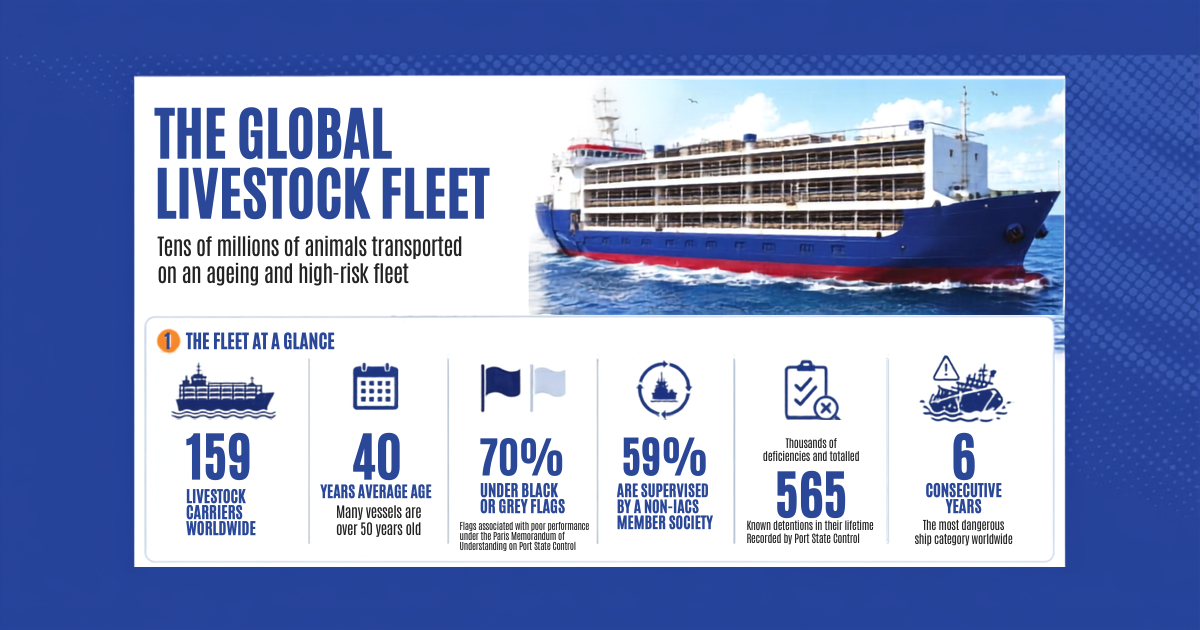
The letter, sent on 21 July 2026 on behalf of the Global Stop Live Exports Network, cites the newly released 2026 Global Livestock Fleet Report, an independent analysis by Robin des Bois, Animal Welfare Foundation and Tierschutzbund Zurich covering 159 vessels involved in maritime livestock transport worldwide.
Key findings cited in the letter include:
- The average converted livestock carrier is 45 years old, with 51 vessels aged 50 years or more.
- 84% of the fleet (134 of 159 vessels) was never purpose-built for livestock transport.
- 47.3% of the fleet flies flags blacklisted by the Paris Memorandum of Understanding.
- Livestock carriers have been the worst-performing vessel category recorded by the Paris MoU for at least six consecutive years, with a detention rate of 15.1% in 2024, almost four times the average across all inspected ship types.
- 54.7% of the fleet is owned by shell companies, most of them single-ship entities registered in tax havens, complicating liability recovery when vessels are lost or abandoned.
Lisa Baker, President of Stop Live Exports Australia, who signed the letter on behalf of the network, said it was not a call on the ethics of live export.
“This is a request to examine the documented maritime risk profile of this vessel category, and to consider whether current underwriting practices, industry due diligence standards and reputational exposure frameworks adequately reflect that risk,” Baker said.
The letter asks IUMI and its member associations to commission an independent actuarial assessment of the livestock carrier fleet, develop industry-wide due diligence standards for underwriting livestock carrier risk, review whether current premium structures reflect the documented risk profile, and consider the reputational exposure to member underwriters of continued association with the sector.
The network has requested a meeting with IUMI representatives to discuss the report’s findings.
ENDS
Media contact: Ruth Gourley media@stopliveexports.org
Notes to editors:
- The full letter is available at this link https://stopliveexports.org/wp-content/uploads/2026/07/Letter-to-IUMI-210726.pdf.
- The Report is available here: 2026 Global Livestock Fleet Report
- The Global Stop Live Exports Network comprises 38 animal welfare and protection organisations across Europe, Australia, South Africa and Latin America.